


Key Takeaways
- Medicare Part D plans change every year, affecting premiums, deductibles, and formularies.
- The 2026 Part D benefit structure eliminates the 'donut hole' and introduces a simplified three-phase system with an out-of-pocket cap.
- The maximum deductible for 2026 is $615, and the catastrophic phase threshold is $2,100 in out-of-pocket costs.
- Review your Annual Notice of Change (ANOC) carefully each fall to understand premium increases, formulary changes, and pharmacy network updates.
- Switching plans may be necessary if your current plan no longer covers your medications or becomes too expensive.
What Are Medicare Part D Plan Changes and Why They Matter in 2026
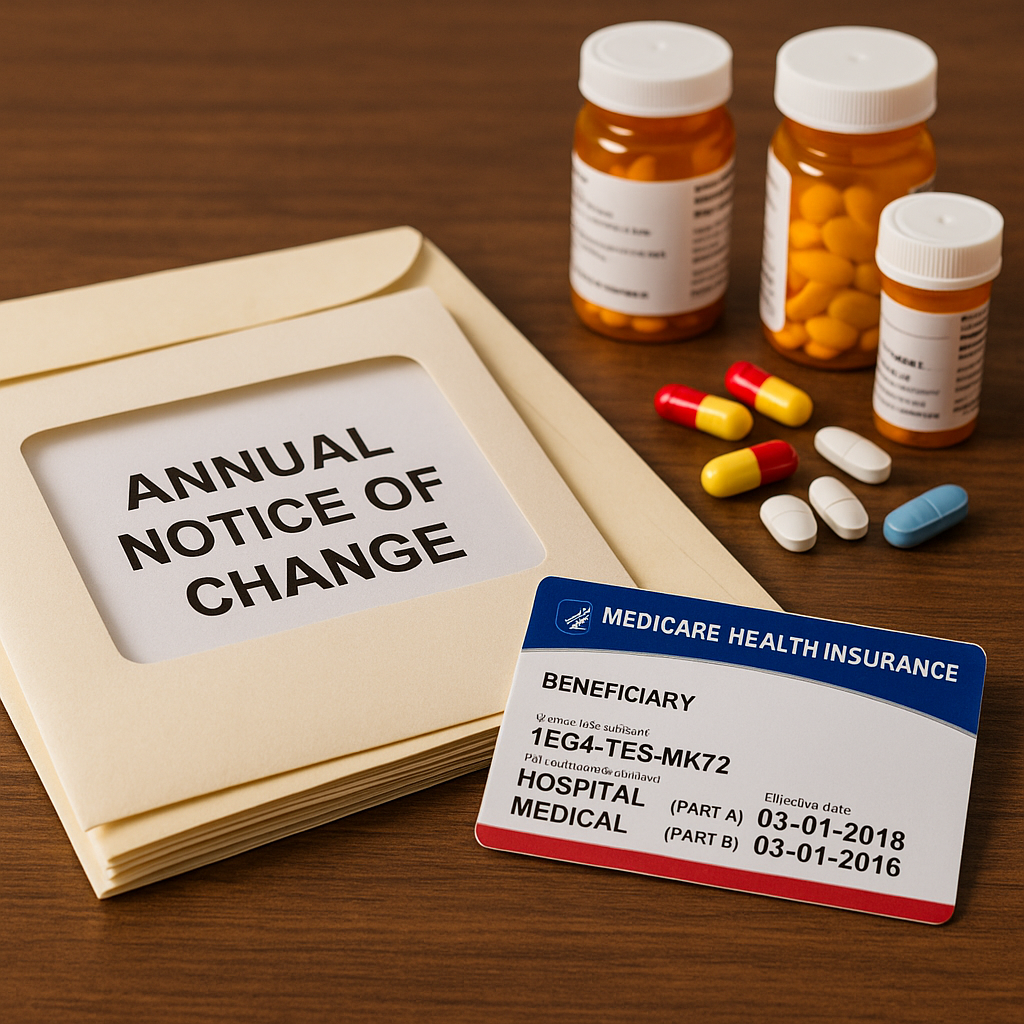
Every fall, millions of Medicare beneficiaries receive a thick envelope in the mail, and most set it aside unopened. That envelope contains the Annual Notice of Change (ANOC), and ignoring it could cost you hundreds of dollars in unexpected prescription drug expenses next year.
Don't Ignore Your ANOC!
The Annual Notice of Change (ANOC) contains vital information about your Part D plan's premiums, deductibles, and covered drugs for the upcoming year. Failing to review it could lead to significant unexpected costs.
Medicare Part D plan changes happen every year. Premiums shift. Deductibles rise. Formularies, the lists of covered drugs, get revised. Your plan from 2025 is not automatically the right plan for 2026, even if nothing in your health situation has changed.
In 2026, several key cost updates took effect. The average monthly Part D premium is $34.50, the maximum annual deductible increased to $615 (up from $590 in 2025), and the catastrophic phase threshold rose to $2,100 out-of-pocket, according to the Centers for Medicare & Medicaid Services (CMS). These are not minor adjustments; they directly affect how much you pay at the pharmacy each month.
| Cost Component | 2025 Amount | 2026 Amount |
|---|---|---|
| Average Monthly Premium | Varies by plan | $34.50 |
| Maximum Annual Deductible | $590 | $615 |
| Catastrophic Phase Threshold (Out-of-Pocket) | $2,000 | $2,100 |
When your ANOC arrives in September, read the formulary section and cost-sharing tables carefully. Look for any drugs that changed tiers, any premium increases, and any pharmacy network updates. Reviewing your plan annually is the single most reliable way to protect your prescription drug budget.
How the 2026 Medicare Part D Benefit Structure Has Changed
The Inflation Reduction Act (IRA) fundamentally restructured how Part D works, and 2026 marks another year of those reforms taking hold. Most notably, the traditional coverage gap (commonly called the donut hole) has been eliminated. In its place is a simplified three-phase benefit with a true annual out-of-pocket cap.
Out-of-Pocket Cap for Part D
As Tricia Neuman, Senior Vice President and Executive Director of the Program on Medicare Policy at KFF, put it: "Millions of Medicare beneficiaries stand to benefit from the out-of-pocket cap on drug spending, which for the first time gives people with high drug costs real financial protection under Part D."
Here is how the 2026 benefit phases break down:
Deductible phase: You pay 100% of drug costs until you meet your plan's deductible, up to a maximum of $615.
Initial coverage phase: You pay your plan's copays or coinsurance on covered drugs while your plan covers the rest.
Catastrophic phase: Once you reach $2,100 in true out-of-pocket drug costs, your cost-sharing drops to $0 for covered drugs through year-end.
To make this concrete: a beneficiary taking two brand-name medications who reaches the $2,100 catastrophic threshold pays nothing more for those drugs for the remainder of the year. Under the old donut hole structure, that same person would have faced a coverage gap requiring them to pay a significant share of costs before catastrophic coverage kicked in at a much higher threshold.
Still, as David Lipschutz of the Center for Medicare Advocacy notes, formulary changes and shifting cost-sharing structures can significantly affect what beneficiaries pay out of pocket, even within this improved framework. Plan differences matter enormously.
7 Critical Signs It Is Time to Switch Your Medicare Part D Plan
Recognizing when your current plan no longer serves you is the first step toward better coverage. Here are seven concrete warning signs.
Sign 1, Your Drug Is No Longer on the Formulary or Moved to a Higher Tier
Part D formulary changes are one of the most common reasons costs spike unexpectedly. A medication moving from Tier 2 to Tier 4 can triple your monthly copay overnight. Check your ANOC's formulary section against your current prescriptions every fall.
Sign 2, Your Monthly Premium Increased Significantly
A $15 monthly premium increase may seem small, but it adds $180 annually. A thorough [Medicare Part D comparison](/faqs/medicare-part-d-enrollment/) during open enrollment may reveal a plan with identical or better drug coverage at a lower cost.
Sign 3, Your Preferred Pharmacy Is No Longer In-Network
Preferred pharmacy networks directly affect your copays. Using a non-preferred pharmacy can cost significantly more per prescription under the updated cost-sharing structures. If your regular pharmacy lost preferred status, a plan switch may save you money without changing where you fill prescriptions.
Sign 4, Your Out-of-Pocket Costs Rose Even Though Your Drugs Did Not Change
With the 2026 maximum deductible now at $615, some plans have increased their deductibles while keeping premiums stable. If your costs climbed without a formulary reason, review your plan's cost-sharing structure line by line.
Sign 5, You Now Qualify for Extra Help (Low-Income Subsidy)
If your income is at or below $23,475 (individual) or $31,725 (married couple) the 2025 limits set by the Social Security Administration, you may qualify for Extra Help. This program can dramatically reduce premiums and cost-sharing, and it also qualifies you for a Special Enrollment Period to switch plans outside of open enrollment.

I always tell people to check their Extra Help eligibility, even if they think they won't qualify. The income limits are more generous than many realize, and the savings can be life-changing. It also gives you the flexibility to switch plans anytime, which is a huge advantage.
Sign 6, You Enrolled in or Left a Medicare Advantage Plan
Medicare Advantage plans with drug coverage (MA-PD) and standalone Part D plans follow different formulary rules. Switching between plan types always warrants a fresh formulary review. You cannot hold both simultaneously, so timing matters when making this change.
Sign 7, A New Prescription Was Added to Your Regimen
Adding one high-cost medication can make your current plan far more expensive than alternatives on the market. Even a single specialty drug can shift your total annual cost by thousands of dollars depending on how your plan tiers that medication. A Medicare drug plan review when your prescriptions change is always worthwhile.
How Medicare Part D Plan Changes Affect Your Prescriptions
Plans can revise their formularies at the start of each plan year, and sometimes mid-year under specific circumstances. When a drug is removed or reclassified, two immediate protections apply: a transition fill (a temporary supply to prevent a gap) and the right to request a formulary exception if your prescriber documents medical necessity.
Plans can also add prior authorization requirements or step therapy rules to medications that previously had neither. Step therapy requires trying a lower-cost alternative before the plan approves the drug your doctor originally prescribed. These requirements can affect both access and the timing of your treatment.
Understanding Coverage Determinations and Appeals
If your plan drops a drug or adds new restrictions, you have the right to file a coverage determination or appeal. Medicare.gov provides official guidance on the appeals process, including timelines and required documentation. Acting quickly matters; standard decisions are typically issued within 72 hours, while expedited decisions are issued within 24 hours for urgent situations.
When your ANOC arrives, focus specifically on the formulary and pharmacy network sections. These are where the most impactful medicare drug plan updates typically appear, and where advance review can prevent a costly surprise in January.
When to Act: The Medicare Annual Enrollment Period and Your Switching Window
The [Medicare Annual Enrollment Period](/faqs/medicare-annual-enrollment-period/) runs from October 15 through December 7 each year. Any Part D plan change made during this window takes effect January 1 of the following year. This is your primary opportunity to switch plans, drop a plan, or add drug coverage.
Outside of open enrollment, Special Enrollment Periods (SEPs) allow mid-year changes in specific situations; qualifying for Extra Help, relocating to a new service area, or losing other creditable drug coverage are common triggers. These SEPs ensure you are not locked into a plan that no longer fits your circumstances.
Medicare Part D Late Enrollment Penalty
The Medicare Part D late enrollment penalty is a permanent surcharge calculated at 1% of the base premium ($38.99 in 2026) for each month you went without creditable drug coverage. A 12-month gap, for example, adds roughly $4.68 per month to your premium, permanently. Enrolling on time is essential.
Start your medicare drug plan review in September when ANOC documents arrive. That gives you several weeks to compare options before October 15, rather than rushing decisions at the deadline.
How to Compare and Switch Medicare Part D Plans Step by Step
Switching plans is straightforward when you approach it systematically. Follow these steps:
Gather your prescription list: Write down each drug name, dosage, and how often you take it.
Use the Medicare Plan Finder: Enter your drugs and preferred pharmacy at Medicare.gov for a side-by-side Medicare Part D comparison showing estimated annual costs per plan.
Evaluate total annual cost, not just the monthly premium: Factor in the deductible, copays by tier, and whether your drugs fall on preferred tiers. A $0 premium plan with a $615 deductible may cost more than a $35/month plan with a lower deductible.
Confirm your pharmacy's network status: Preferred pharmacies offer lower cost-sharing. Verify before enrolling.
Check IRMAA surcharges if your income is higher: If your 2024 income exceeded $109,000 (individual) or $218,000 (joint), you will pay an additional $14.50 to $91.00 per month on top of your plan premium in 2026, per CMS and SSA data. Factor this into your total cost calculation.
Enroll through Medicare.gov, by calling 1-800-MEDICARE, or with a licensed Medicare agent: Confirm your enrollment confirmation and new plan card arrive before January 1.
Medicare Advantage Drug Coverage vs. Standalone Part D: What Changes When You Switch
Medicare Advantage plans with drug coverage (MA-PD) and standalone Part D plans operate under different formulary and cost-sharing structures. Comparing the two requires looking beyond drug costs alone; MA-PD plans often include dental, vision, and other benefits that affect total coverage value.
Beneficiaries leaving a Medicare Advantage plan during open enrollment who do not enroll in a new MA-PD plan must pick up a standalone Part D plan to maintain prescription drug coverage. A gap in coverage, even a brief one, can trigger the late enrollment penalty if it exceeds 63 days.
Important Rule: No Dual Coverage
You cannot hold both a standalone Part D plan and an MA-PD plan simultaneously. If you enroll in one, the other is automatically terminated. Understanding this before you switch prevents accidental coverage gaps or duplicate billing issues.
For a detailed look at how these coverage types compare overall, the Original Medicare vs. Medicare Advantage breakdown is a useful starting point before making any plan-type switch.
Extra Help and Other Resources to Lower Your Part D Prescription Drug Costs
Extra Help, also called the Low-Income Subsidy, is a federal program that can reduce or eliminate Part D premiums, deductibles, and copays. The 2025 income eligibility limits are $23,475 for individuals and $31,725 for married couples, according to the Social Security Administration and the National Council on Aging. Many eligible beneficiaries do not realize they qualify.
Qualifying for Extra Help also triggers a Special Enrollment Period, allowing you to switch Part D plans at any time outside the standard open enrollment window. This flexibility is especially valuable if your current plan becomes a poor fit mid-year.
Beyond Extra Help, additional support options include:
Medicare Savings Programs: State programs that may cover Part B premiums and reduce out-of-pocket costs for qualifying beneficiaries.
State Pharmaceutical Assistance Programs (SPAPs): Vary by state but can supplement Part D coverage with additional drug cost assistance.
Manufacturer Patient Assistance Programs: Some drug manufacturers offer free or reduced-cost medications for qualifying patients.
If you are sorting through IRMAA surcharges, Extra Help eligibility, and formulary changes at the same time, working with a licensed Medicare agent or a State Health Insurance Assistance Program (SHIP) counselor can make the process significantly clearer. These resources are available at no cost and provide personalized plan comparison support. You can also explore the Medicare Extra Help program details to understand what documentation you will need to apply.
Frequently Asked Questions About Medicare Part D Plan Changes
Related Articles
Have Medicare questions?
Our licensed Medicare agents are available to help you find the right coverage.